
Variants of the M‑1 Sokol Aircraft
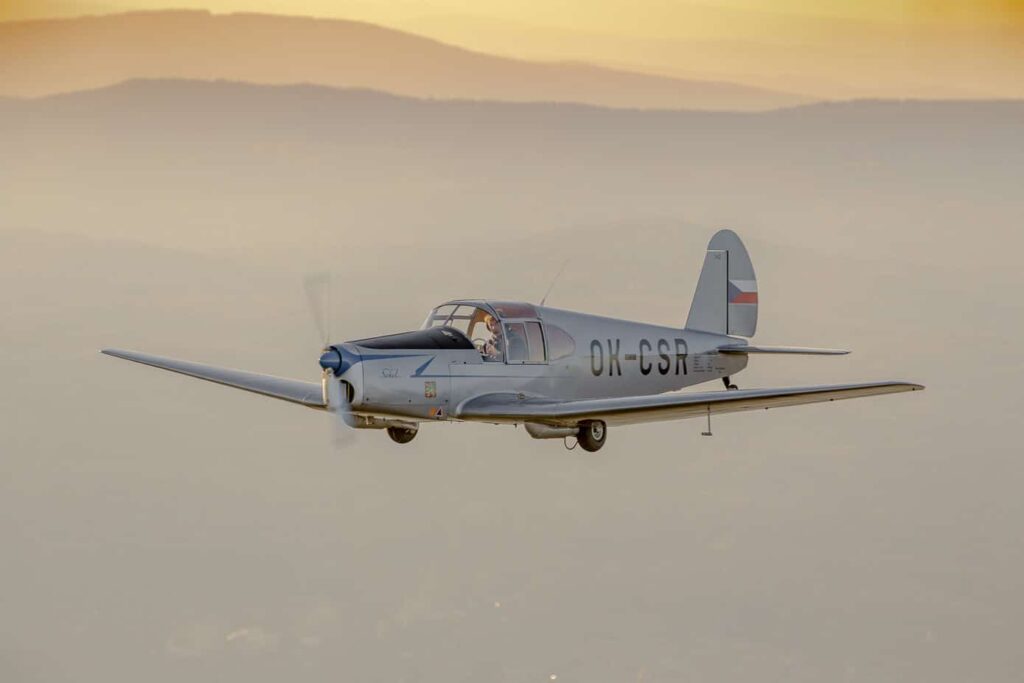
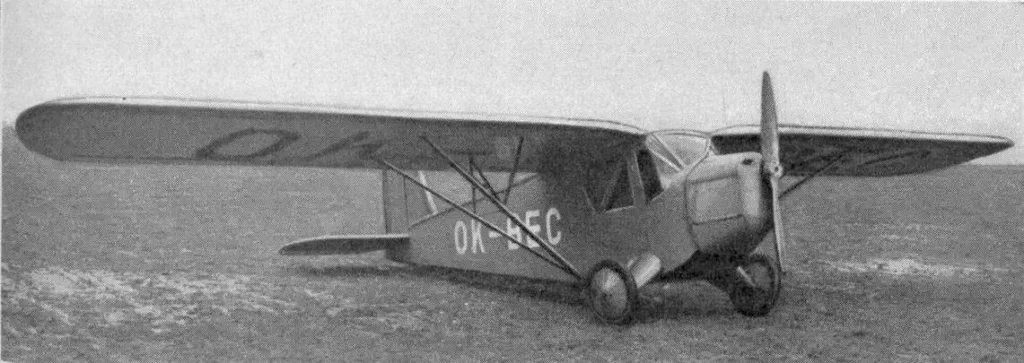
The Sokol underwent rapid development and several versions were created. The M‑1B was a variant equipped with the Zlín‑built Toma 4 engine, which ultimately proved unsuitable due to its lower power output. The M‑1C was a three‑seat version developed in response to demand for touring aircraft (a modification of the wing to a slight sweep also solved stability issues). The M‑1D was a modernised version with a redesigned canopy for improved visibility, and the M‑1E was a floatplane version. Sokol aircraft also served in the military under the designation K‑63, with some adapted for parachute‑training purposes.
Promotional Flight of the M‑1 Sokol to Cape Town (1947)
To help the new Czechoslovak sport aircraft succeed on the world market, the company Beneš & Mráz (the name “Orličan” was adopted only in 1955) launched an ambitious promotional campaign: a long‑distance flight across Africa to Cape Town. On 1 April 1947, two Sokols — OK‑AHN and OK‑AHK — took off from Prague with crews Mlejnecký–Sajfrt and Nováček–Kunz. The goal was to demonstrate the aircraft’s reliability, performance, and durability under extreme conditions.
The route led across the Balkans, the Middle East, and East Africa. Both crews and aircraft had to endure high temperatures, sand, tropical storms, and long stretches without any possibility of an emergency landing. During the crossing of Kenya, however, an accident occurred: the OK‑AHK struck power lines during low‑level flight and crashed. Fortunately, the crew suffered only minor injuries, but the aircraft was destroyed.
The second aircraft, OK‑AHN, continued. On 26 April 1947, it successfully landed in Cape Town, becoming the first Czechoslovak aircraft to reach the city “on its own wings”. After a series of demonstration flights, the crew set off on the return journey and landed in Prague on 28 May. The promotional mission attracted international attention and confirmed that the Sokol was capable of long and demanding routes.
M‑1 Sokol Holds Several International Records
The Sokol achieved a number of FAI international records. Pilot František Novák set several long‑distance records on triangular and straight‑line routes, including a 4,450‑km flight to what was then the Kazakh SSR. Another pilot, Luboš Šťastný, specialised in speed records and, with a modified Sokol, reached speeds exceeding 280 km/h on routes up to 2,000 km. The aircraft also excelled in competitions — in 1947, a Czechoslovak crew won the Galop d'Essai du Tour de Cadran in France thanks to high average speed and low fuel consumption.
A Symbol of Domestic Sport Aviation, Today Displayed at the National Technical Museum
The M‑1 Sokol was not only the first post‑war Czechoslovak aircraft; it was a machine capable of competing with world‑class designs, collecting records, and proving that the Czechoslovak engineering tradition still had much to offer after the war. It remains one of the most iconic symbols of domestic sport aviation. One example can be seen at the National Technical Museum in Prague. The M‑8 Eagle is its proud great‑grandson.