Preparation
No special preparation is required for an introductory flight. We only recommend a light meal (not on an empty stomach, but nothing heavy either) and rather sporty clothing. The aircraft is equipped with heating, so even on cold winter days there is no need to board wearing a heavy coat.
In most cases, the flight takes place from the airport in Ústí nad Orlicí (LKUO). Besides the option of arriving in your own aircraft, you can also take advantage of the excellent train connection from Prague. However, there is one important limitation we cannot influence – the weather. It is always the final authority in deciding whether the flight can take place. Safety always comes before any planned schedule.
Before the flight
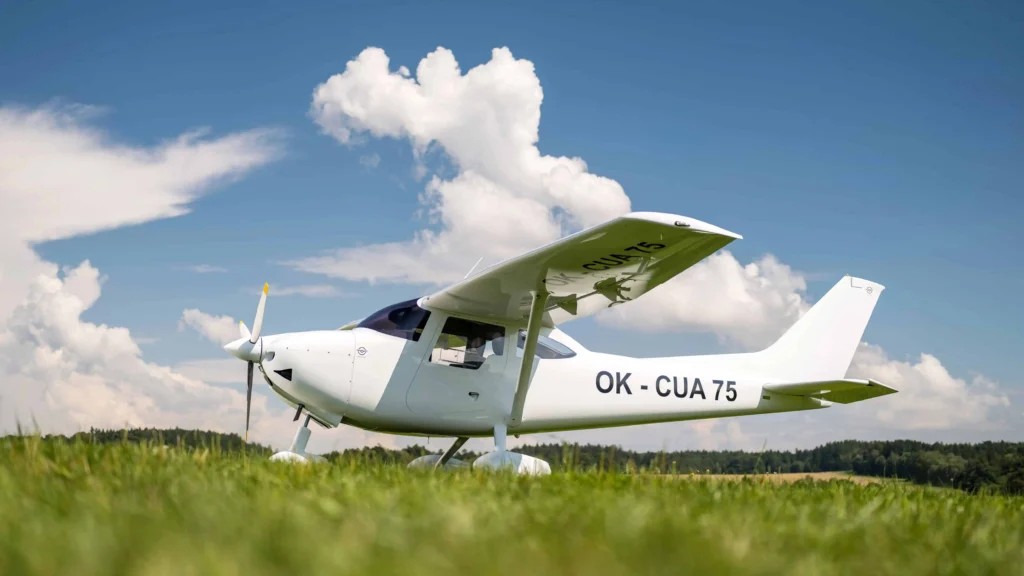
If you haven’t seen the M‑8 EAGLE at an exhibition or at our facility, we will introduce you to the philosophy, systems, and technical solutions of our aircraft, the type of flying it is designed for, and the behavior you can expect as a pilot.
Before the flight itself, we will explain the entire course of the flight – its duration and profile. This is not an aerobatic flight; we want to enjoy flying, and we want you to enjoy it with us. Naturally, we will also provide a safety briefing: boarding and exiting, seat belts, doors, ventilation, intercom communication, the “sterile cockpit” during takeoff and landing (limit communication to the essentials during these phases), and procedures in case of discomfort or an emergency.
How the flight proceeds
After taxiing to the runway (the direction of flight is determined by the current wind) and reaching the runway threshold, the pilot will ask once more if everything is fine and if he may continue. After a short takeoff roll of roughly 200 meters, the aircraft lifts off and climbs to cruising altitude, which takes a few minutes. This is followed by mostly horizontal flight demonstrating stability and controllability.
If you are a pilot, you can of course try the aircraft in flight – how it responds, how predictable it is, and how quickly you “click” with it. If you do not yet have pilot training, a flight instructor will accompany you and allow you to try the controls, though not across the full flight envelope.
The flight then returns to the airport, enters the traffic pattern, and lands. In most cases, passengers describe their first experience in a light aircraft as more pleasant than flying on an airliner. We sometimes jokingly call our aircraft “the banana plane” – most people step out of the Eagle with a smile from ear to ear.
Communicate openly with us and address any discomfort immediately. You may, of course, request to interrupt the flight at any time, for any reason, which you do not need to explain.
After landing
After the flight, the pilot will review the experience with you, and you can share your impressions and ask any additional questions.