Design Philosophy: A Clean Low‑Wing as the New Standard
By the mid‑1930s, Ing. Pavel Beneš was convinced that the cantilever low‑wing configuration represented the optimal aircraft layout for most purposes – from training to touring. The Beta Minor was the first aircraft in which this philosophy fully materialised.
Its structure was entirely wooden, with a clean aerodynamic form free of external bracing. The wing featured a relatively high aspect ratio, and together with effective flaps it contributed to low drag and solid performance despite the relatively modest 90 HP Walter Minor engine.
The tandem cockpit arrangement and the inverted inline four‑cylinder engine significantly reduced the frontal area. Beneš thus achieved a level of aerodynamic cleanliness that was above average for light training aircraft of the period.
Aerodynamics: Beneš’s Airfoil and Longitudinal Trim
The second prototype introduced longitudinal trim, which at the time was not yet a universal feature. It allowed pilots to eliminate continuous control forces in most flight regimes – a notable improvement in ergonomics and safety.
Beneš again used his proven airfoil, created by combining the M 6 and Boeing 106 R profiles and inspired by NACA methods. Post‑war wind‑tunnel measurements confirmed that the airfoil exhibited the characteristics Beneš had theoretically predicted. His successor, Zdeněk Rublič, continued to use it in his designs long after the war.
Landing Gear: A Swinging Strut That Stirred Opinions
One of the most debated features of the Be 50 was its swinging‑strut landing gear. The massive aerodynamic fairings – the “trousers” – looked robust and aesthetically ambiguous.
The gear consisted of a welded tubular frame pivoted to a steel main leg anchored in the centre‑section. A spring and shock absorber provided generous travel and effective damping of landing loads. Early “fifties” used Dowty friction dampers, which tended to “bite” when poorly adjusted. Pilots recalled their creaking during taxiing and the way the metal fairings “sang” during aerobatics.
For courier service, standardised Elkola 420×150 wheels, manufactured under Bendix licence, were later prescribed.
Performance and Handling Characteristics
Although the Beta Minor was not a high‑performance aircraft, its combination of low weight, clean aerodynamics and effective flaps gave it surprisingly good parameters.
- maximum speed: 180–200 km/h
- range: up to 800 km
- excellent low‑speed behaviour – crucial for training
- short take‑off and landing thanks to flaps
Operations: From Aeroclubs to Competitions
The Beta Minor quickly became a favourite among Czechoslovak aeroclubs. In September 1935 it was entered into the 2nd National Flight of the RČS, where it performed well despite a delay caused by a fuel‑system issue.
In 1936 the factory began delivering the first series aircraft to aeroclubs. A total of 54 Be 50s were built, used for training, touring and aerobatics. The Beta Minor took part in competitions both at home and abroad – Angers, Lyon, Paris, Raduno del Littorio.
After the occupation, the aircraft were seized – some taken over by the Slovak State, others by the Luftwaffe, which used them as liaison and training aircraft.
Place in the Emerging Beneš–Mráz Lineage
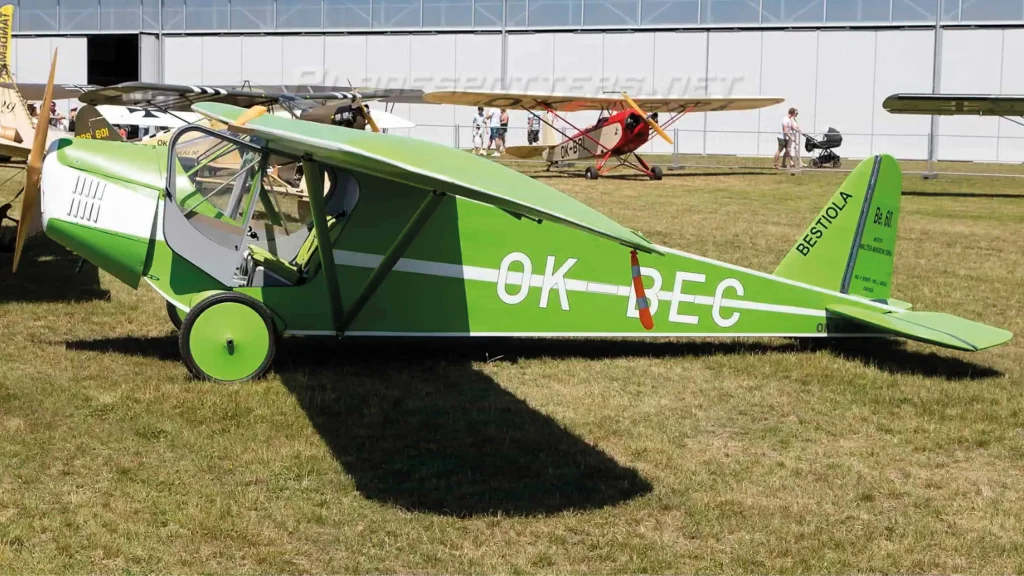
The Beta Minor was the first truly modern type produced by Beneš–Mráz. From the Bestiola it inherited the basic construction approach, but added clean aerodynamics, effective flaps, longitudinal trim, improved ergonomics and broader operational capability.
It became the foundation for an entire family of types – Be 51, Be 52, Be 56 – which gradually developed its concept.
From the Be 50 to the M‑8 EAGLE: Continuity of a Design School
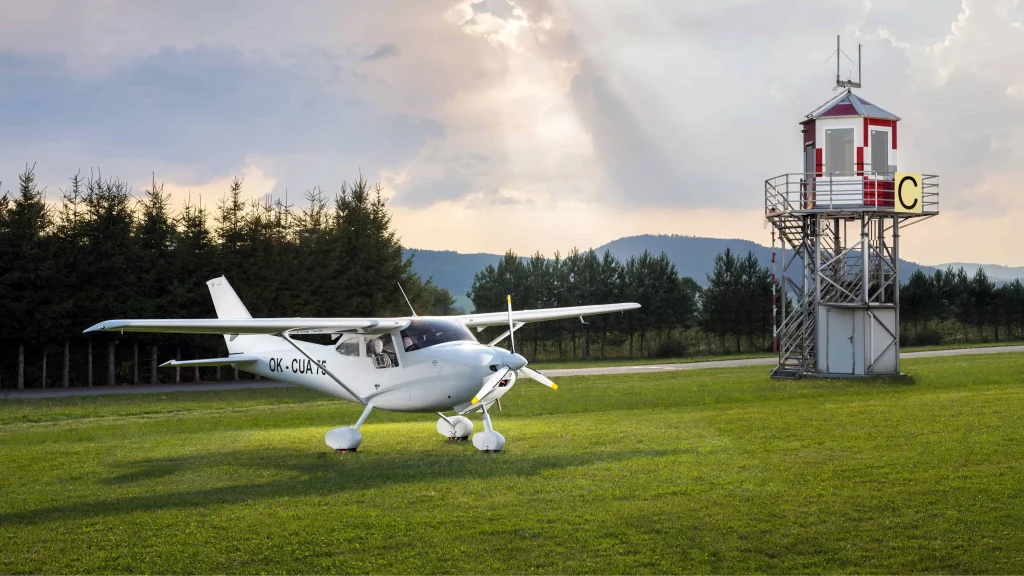
Today’s Orličan M‑8 EAGLE is, at first glance, a modern composite aircraft, yet its design DNA carries surprising echoes of the Be 50 Beta Minor.
Unlike Beneš in the 1930s, Orličan now builds around a high‑wing configuration, considered optimal for modern training, travel and sport flying. The M‑8 EAGLE also uses a composite, not wooden, wing – but the underlying philosophy remains the same: a clean aerodynamic form without unnecessary drag‑inducing elements.
The Beta Minor was exceptionally clean for its time; the M‑8 EAGLE advances this tradition with carbon composites, smooth surfaces free of irregularities, a CFD‑optimised wing profile and low drag even at higher speeds.
Longitudinal trim was a novelty on the Be 50. The M‑8 EAGLE continues this lineage with stable handling across the entire speed range, modern Garmin avionics and an unusually spacious cabin designed for long flights and training.
The Beta Minor was light, economical and versatile. The M‑8 EAGLE is its modern parallel: a cruise speed around 220 km/h, range over 1300 km, low fuel consumption (approx. 13 l/h at 180 km/h), optional IFR equipment and high operational flexibility – suitable for aeroclubs, private pilots and professional training.
The Be 50 Beta Minor was not just a modern two‑seater of its era. It embodied a design philosophy that has endured for 90 years. Today’s M‑8 EAGLE is its natural continuation – modern, composite, fast, yet still faithful to the core principle: a clean, light, efficient aircraft for pilots who know what they want.
Sources:
Marjánek, P. – Křídla nad Orlicí
Documentation and records of the Ministry of National Defence (MNO)
Test reports of the Military Technical and Aviation Institute (VTLÚ)
Period photographs and technical sheets from aviation collections and museums