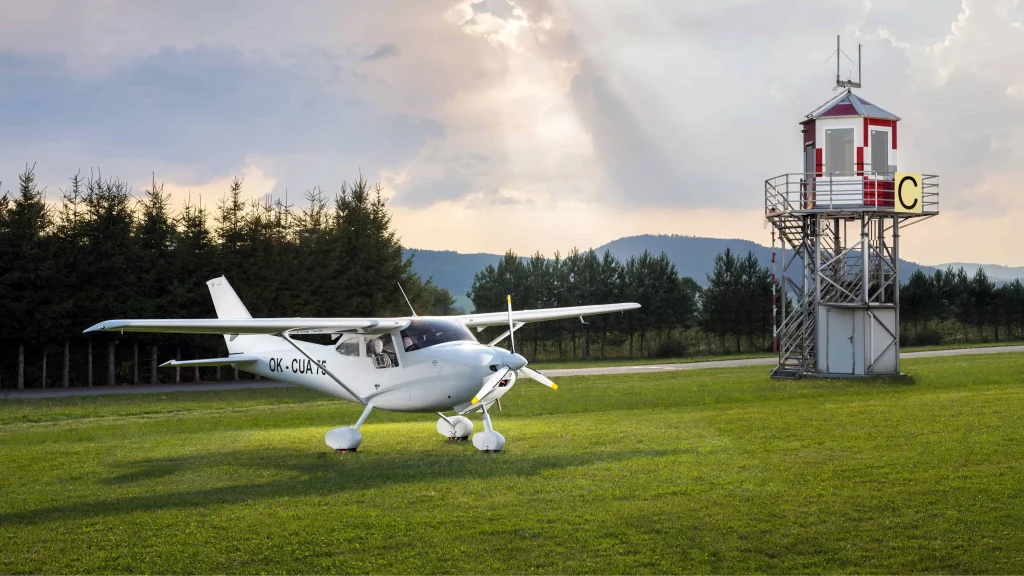
When the company Ing. P. Beneš, Ing. J. Mráz, Aircraft Factory was founded in Choceň on 1 April 1935, it needed one thing above all: a first type on which the entire enterprise would learn to design, build, and operate an aircraft from start to finish. That type became the Be 60 Bestiola — a light sport, touring, and training aircraft intended for aeroclubs and flying schools.
The Bestiola was neither record‑breaking nor showy. Its significance lay elsewhere: it enabled the factory to start production quickly, establish processes, gain its first customers, and prove that the new team in Choceň could deliver a complete and reliable aircraft. That is why it stands at the very beginning of the line that leads all the way to today’s M‑8 EAGLE.
Development: From First Flight to Series Production
The first Bestiola prototype flew on 10 July 1935, piloted by the factory test pilot Josef Koukal. The test flights revealed shortcomings — poor climb performance and a “heavy nose.” A modification followed: a lengthened fuselage and increased wingspan. The modified prototype flew again on 13 August 1935 and successfully passed the official Ministry of Public Works test on 29 August. It was entered into the aircraft register on 13 September 1935 as OK‑BEA.
The second prototype, completed on 3 October 1935 (OK‑BEC), already matched the configuration of later production aircraft. It underwent testing at the Military Technical and Aviation Institute (VTLÚ), which led, among other things, to the replacement of foreign instruments with domestic ones. The Ministry of National Defence (MNO) subsequently ordered a series of 20 aircraft.
A total of 23 Bestiolas were built in 1935–1936. The first three were taken over by the Ministry of Public Works, the remaining 19 by the MNO. The aircraft were assigned to Czechoslovak aeroclubs and branches of the Masaryk Aviation League for pilot training — nine in Bohemia, six in Moravia, and three in Slovakia. The last aircraft produced, OK‑BEM, remained with the factory for company and promotional flights.
How the Bestiola Looked: Colours, Markings, Details
From the book Křídla nad Orlicí we know that the Bestiola was not just a “type,” but a very specific and visually distinctive aircraft.
Prototype No. 1, OK‑BEA
- Base colour: cream
- Red areas: forward fuselage, wing leading edges, arc on the lower fin
- Registration: large red letters OK‑BEA
- The rudder carried the typical Choceň inscription:
BE 60 WALTER MIKRON 40 HP ING. P. BENEŠ A ING. J. MRÁZ CHOCEŇ
This format was never entirely uniform — the engine line was often omitted, and sometimes the phrase TOVÁRNA LETADEL (Aircraft Factory)
Prototype No. 2, OK‑BEC
- First flown in dark red (same as Be 50 Beta Minor No. 1, OK‑BEB)
- Black registration
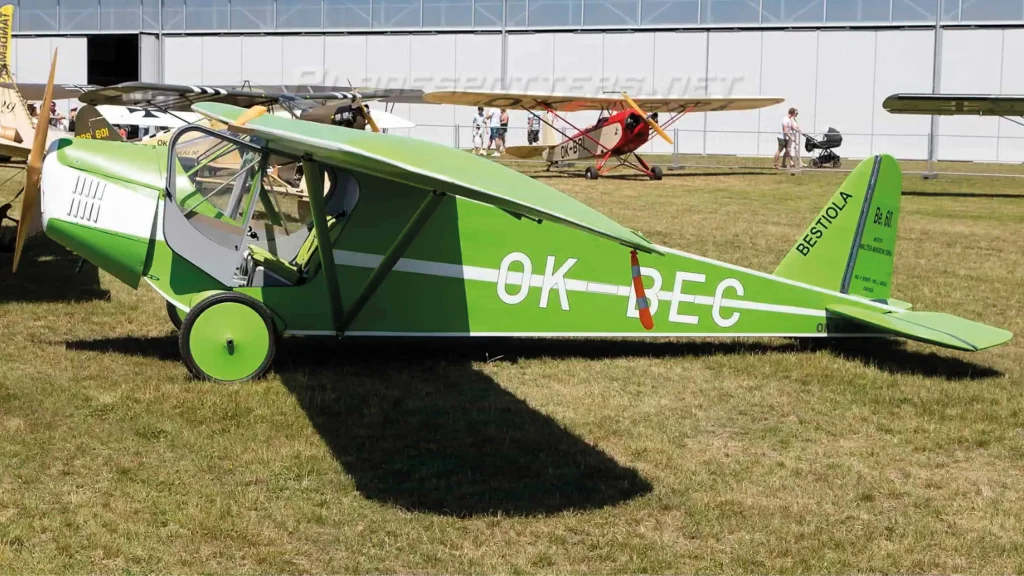
- After returning from a promotional flight to Yugoslavia, repainted entirely in green with white letters
- Delivered to VTLÚ in this scheme
- Ing. Pavel Beneš decided that aircraft intended “for the military” would be green — establishing a basic visual standard.
Aircraft No. 3, OK‑BEE
- Base colour: green
- Details: white registration, white fuselage edges, white wing leading edges
- White engine cowling transitioning into a white fuselage stripe
- Black Bestiola inscription on the fin, parallel to the leading edge — a motif adopted by all series aircraft
The same scheme was used on aircraft No. 101 (serial No. 23), OK‑BEM, which remained with the factory for company and promotional flights.
Series Aircraft No. 4–22
- Uniform green finish without additional markings
- Standard inscriptions on the rudder and fin
- Under the left wing, the prescribed MNO identification: Be 60 – serial number
- Aircraft taken over by the military were initially without registrations — these were added later in air depots or aeroclubs, without a unified instruction, resulting in significant variation.
Construction and Technical Data
The Bestiola was an all‑wood high‑wing monoplane with struts, a tailwheel undercarriage, and a two‑seat side‑by‑side enclosed cockpit. The structure was wooden, covered with plywood and partly with fabric.
Basic technical data (Walter Mikron II engine):
- Wingspan: 11.2 m
- Length: 6.65 m
- Wing area: 15.2 m²
- Empty weight: approx. 290–300 kg
- Take‑off weight: approx. 490–525 kg
- Engine: Walter Mikron II, inverted inline four‑cylinder, 60 hp (44.2 kW) at 2600 rpm
- Maximum speed: approx. 142–150 km/h
- Cruise speed: 125 km/h
- Landing speed: 55 km/h
- Range: 470 km
- Service ceiling: 3400 m
- Take‑off run: 90 m
- Landing roll: 60 m
These parameters show that the Bestiola was not a “performance” aircraft, but a practical training and touring machine: short take‑off, low landing speed, simple maintenance.
In Service: Aeroclubs, Training, Occupation
The Bestiola was designed from the outset as an aircraft for aeroclubs and flying schools. After being taken over by state institutions, all aircraft were assigned to Czechoslovak aeroclubs and branches of the Masaryk Aviation League for pilot training.
After the occupation of Czechoslovakia, the Bestiola continued in its role as a light training and touring aircraft — used also by the Germans, often in its original green scheme. Surviving information and photographs from this period are scarce, but even that confirms that the Bestiola was regarded as a utility aircraft, not a frontline type.
The Bestiola Today: A Replica and a Living Tradition
The story of the Bestiola does not end in the archives. In recent years, a full‑scale 1:1 replica of the Be 60 was built using the surviving 1935 drawings. The aircraft, built by Petr Tax, flies with a modern Suzuki 1.6 engine — chosen for its higher power for towing ultralight gliders — and carries the registration OK‑VAU88.
Its concept, proportions, and flight character remain faithful to the original. The Bestiola now flies again at airshows, reminding us that the first type from Choceň was not just a historical footnote, but a fully capable aircraft — one that can still fly today.
Bestiola as the Beginning of the Orličan Line
When we look at the M‑8 EAGLE today, we see a composite, modern aircraft with international ambition and heated seats. But the line that leads to it does not begin with carbon — it begins with a wooden high‑wing monoplane powered by a Mikron engine, painted cream or green, with a hand‑painted Bestiola inscription on the fin.
The Bestiola was:
- the first design of the new factory,
- the production “textbook” for the entire team,
- the workhorse of aeroclubs,
- and the founder of the Orličan tradition.
It became the first proven type demonstrating that the new Choceň team could handle the complete development and production of its own aircraft. And although the company Beneš & Mráz changed several times in the decades that followed before becoming today’s Orličan, one principle remained: the competence to design and manufacture aircraft that stand up to real‑world operation. That spirit is still present in every part produced in Ústí nad Orlicí — whether for the M‑8 EAGLE or for demanding international partners such as Schempp‑Hirth and Diamond Aircraft.
In the next article, we will return to the aircraft that took over the baton from the Bestiola and first showed the young factory’s ambition on a larger scale — the Be 50 Beta Minor.
Sources:
Marjánek, P. – Křídla nad Orlicí
Archival materials of the Beneš–Mráz Aircraft Factory (1935–1936)
Official test reports of the Ministry of Public Works
Documentation and records of the Ministry of National Defence (MNO)
Test reports of the Military Technical and Aviation Institute (VTLÚ)
Czechoslovak Aircraft Register (1935–1939)
Period photographs and technical sheets from aviation collections and museums
Publicly available technical data on the Walter Mikron engine
Contemporary documentation of the Be 60 replica (OK‑VAU88)